


The Starting-Rate Gap Is Wide Enough to Survive Being Wrong
By: Scott Williams
For most commercial real estate borrowers, the decision between fixed-rate and floating-rate debt has been relatively straightforward over the past several years.
If you had the ability to fix your interest rate, you generally did.
Borrowers who financed with floating-rate debt watched SOFR increase dramatically as the Federal Reserve fought inflation, while borrowers with fixed-rate loans were largely protected from that volatility. In many cases, floating-rate borrowers also incurred meaningful costs for interest-rate caps as short-term rates increased.
Today, however, the math has changed enough that I think the decision deserves another look.
SOFR currently sits at approximately 3.90%, while the 5-year Treasury is approximately 5.08%. That creates a roughly 118-basis-point difference between the two indexes.
The difference in lender spreads is nowhere near that wide.
For comparable transactions, we are generally seeing floating-rate spreads approximately 15–30 basis points wider than five-year fixed-rate spreads. Using a relatively simple example, a floating-rate loan priced at SOFR + 200 would start today at approximately 5.90%. A five-year fixed-rate loan priced at the 5-year Treasury + 180 would start at approximately 6.88%.
That is almost 100 basis points of difference in the starting coupon.
The obvious response is that SOFR may not stay at 3.90%.
In fact, the Fed has already told us it won't.
On September 16th, the Federal Reserve raised its target rate for the first time since 2023, moving from 3.50%–3.75% to 3.75%–4.00%. The vote was unanimous.
Officials were not shy about signaling more. Sixteen of nineteen FOMC participants currently project at least one additional hike before year-end, and futures markets are pricing roughly an 87% probability of at least one more move by December.
In other words, this is no longer a hypothetical. The first hike has happened. The real question is how many more are coming, and how a floating-rate borrower holds up if the Fed moves further than it is currently signaling.
The current SOFR forward curve is pricing in approximately 80 basis points of additional increases over the next twelve months, equivalent to roughly three more quarter-point hikes. That is a meaningfully more aggressive path than the Fed's own dot plot, which currently points to one, or at most two, additional moves this year.
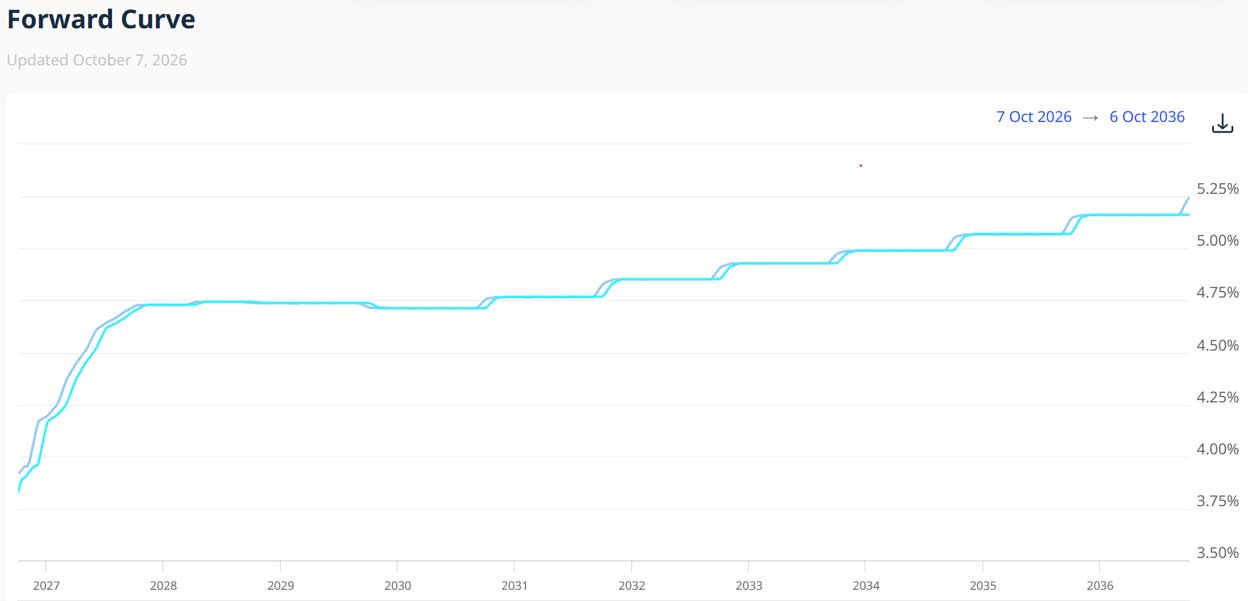
Source: Pensford
I think that gap is useful. Rather than build a scenario around what the Fed says it will do, it is worth testing whether floating-rate debt still works if the Fed does meaningfully more than that.
This is not a scenario built on hoping for cuts. It is a scenario built on the assumption that tightening continues well past what the Fed and the market are currently signaling.
The more relevant question is whether the starting-rate advantage on floating debt is large enough to absorb those increases.
Assume a borrower is evaluating a $10 million interest-only loan with a three-year expected hold period.
The floating-rate option starts at 5.90%.
The five-year fixed-rate option starts at 6.88%.
Now assume the floating-rate borrower gets very little help from the Fed initially.
Over the first twelve months, assume the Fed raises rates three times by 25 basis points, more than it is currently signaling, taking the floating coupon from 5.90% to 6.65%.
Assuming those increases occur relatively evenly throughout the year, the average floating rate during Year 1 would be approximately 6.275%.
Assume rates then remain at 6.65% for the entire second year.
Finally, assume inflation begins to moderate and the Fed cuts rates three times during the third year, bringing the floating rate back down by 75 basis points. Assuming those cuts occur relatively evenly throughout the year, the average floating rate during Year 3 would again be approximately 6.275%.
Under that scenario, estimated interest expense looks like this:
| Year 1 | Year 2 | Year 3 | 3-Year Total | |
|---|---|---|---|---|
| Average Floating Rate | 6.275% | 6.65% | 6.275% | 6.40% avg |
| Floating Interest | $627,500 | $665,000 | $627,500 | $1,920,000 |
| Fixed Rate | 6.88% | 6.88% | 6.88% | 6.88% |
| Fixed Interest | $688,000 | $688,000 | $688,000 | $2,064,000 |
| Floating Savings | $60,500 | $23,000 | $60,500 | $144,000 |
Even after assuming three additional rate hikes beyond what the Fed is currently projecting, holding at the peak for an extended period, and receiving no meaningful relief until the third year, the floating-rate borrower still pays approximately $144,000 less interest over the three-year period.
That does not mean floating-rate debt is automatically the better option.
What it does show is how meaningful the starting-rate advantage has become.
A borrower no longer needs an immediate Fed pivot for the floating-rate strategy to work. There is currently a considerable amount of cushion before the floating coupon reaches the starting rate available on a comparable five-year fixed-rate loan, even if the Fed does more than it is currently telling us it will.
Part of what makes the current environment unusual is the shape of the yield curve.
SOFR is approximately 3.90%.
The 5-year Treasury is approximately 5.08%.
The 10-year Treasury is another roughly 25 basis points higher.
For years, investors became accustomed to looking at interest rates as though they largely moved together. Today, the forces affecting short- and long-term rates are increasingly different.
SOFR is closely tied to Federal Reserve monetary policy. The Fed is currently focused on bringing inflation back toward its 2% target. If it ultimately succeeds, the Fed has a direct mechanism available to lower short-term rates.
Long-term Treasury yields are influenced by that same monetary policy outlook, but they also incorporate inflation expectations, economic growth, Treasury supply and the additional return investors require to commit capital for longer periods.
That last component has become increasingly important.
Federal deficits remain substantial. Treasury issuance continues to increase. Higher interest rates themselves are increasing the government's interest expense, which creates additional borrowing needs. Investors purchasing longer-duration Treasury securities are increasingly demanding additional compensation for holding duration.
In other words, even if the Fed eventually gets inflation under control and begins lowering SOFR, that does not necessarily mean the 5- or 10-year Treasury will fall by the same amount.
That raises what I think is one of the more interesting questions for borrowers today:
Will the Fed get inflation under control before the pressures keeping longer-term Treasury rates elevated begin to normalize?
The same issue becomes more pronounced when evaluating ten-year fixed-rate debt.
The 10-year Treasury is currently approximately 25–30 basis points above the 5-year Treasury.
Ten-year lenders will often offset that difference through a lower credit spread. In today's market, we may see a ten-year execution priced approximately 40 basis points tighter than a comparable five-year loan.
That can make the initial coupon competitive.
But the borrower is making a much larger commitment.
With many ten-year loans, the borrower is locking today's elevated long-term Treasury environment for a decade while also accepting yield maintenance, defeasance, or another significant prepayment restriction.
That may be entirely appropriate for a long-term owner who values certainty and has no expectation of selling or refinancing.
It may be considerably less attractive for an investor executing a three- to five-year business plan.
If the property's value is created, the asset is ready to sell, or more attractive financing becomes available four years from now, the borrower may have correctly executed the real estate strategy and still face an expensive cost to exit the financing.
That flexibility has value.
The decision cannot be made simply by forecasting whether interest rates are going higher or lower.
The appropriate financing should match the underlying investment strategy.
There are also borrower-specific considerations.
A property with significant excess cash flow may be able to absorb another 75 or 100 basis points of SOFR increases without materially affecting the investment thesis. Another transaction may have thin debt-service coverage where even one additional hike creates significant pressure.
Likewise, an investor with a two- or three-year value-add strategy may place substantial value on the ability to repay without penalty. A generational owner of a stabilized asset may value certainty far more than optionality.
Those are fundamentally different borrowers and should not necessarily choose the same debt structure.
I am not making the argument that floating-rate debt is now universally better than fixed-rate debt.
I am also not making the argument that rates are about to fall. The Fed's own guidance currently says the opposite.
The point is that the relative pricing has changed substantially.
A floating-rate borrower today can start nearly 100 basis points below a comparable five-year fixed-rate loan. Based on the example above, that borrower can absorb more tightening than the Fed is currently projecting and still potentially generate lower cumulative interest expense over a shorter hold period.
At the same time, borrowers considering longer-term fixed debt are locking rates at a point when the Treasury curve is carrying significant pressure from inflation, federal borrowing, debt supply and the premium investors require to hold duration.
Fixed-rate debt still provides something extremely valuable: certainty.
But certainty has a price.
For investors with shorter-duration business plans, meaningful prepayment flexibility and the ability to withstand additional Fed tightening, that price may be higher today than it has been in some time.
Floating-rate debt was an easy structure to avoid during much of the last rate cycle.
Today, I think it deserves a much closer look.
Partner with us to navigate the complexities of commercial real estate. Get in touch today to explore how our expertise can unlock the full potential of your real estate investments.