


Commercial Real Estate Lenders Are Back. Unfortunately, So Are Higher Rates.
By: Scott Williams
There is an interesting contradiction developing in the commercial real estate debt markets.
Capital is increasingly abundant.
Cheap capital is not.
Over the past several months, we have seen lenders become as aggressive as they have been at any point in the last three years. Banks that spent much of 2023 and 2024 managing their balance sheets are actively looking for new loans. Debt funds remain aggressive. CMBS markets are functioning. Life companies are competing. On quality transactions, borrowers are frequently receiving multiple viable financing options.
The data supports what we are seeing firsthand.
According to the Mortgage Bankers Association, commercial and multifamily mortgage originations increased 16% year-over-year during the second quarter of 2026 and 12% from the first quarter. Most notably, lending from depository institutions increased 61% from a year earlier. That competition is also showing up in pricing, with Trepp reporting that CRE lending spreads have continued to compress as balance-sheet lenders compete for lower-leverage loans.
In other words, lenders want to lend again.
The problem is what is happening underneath those increasingly competitive spreads.
This week, the 10-year Treasury briefly moved above 4.80%, reaching its highest level since November 2023. The move continues a dramatic reversal from February, when the 10-year briefly fell below 4.00%.
On Tuesday, September 1, the Federal Reserve's published 10-year constant maturity Treasury rate was 4.75%. Today, the 10-year traded as high as approximately 4.82% before retreating.
That means lenders can be significantly more aggressive on spread and still produce a higher all-in borrowing cost for their customers.
A lender that reduces its spread by 25 basis points has unquestionably improved its quote. But if the underlying Treasury has increased by 75 basis points, the borrower is still paying 50 basis points more.
The latest move in rates accelerated following Federal Reserve Chairman Kevin Warsh's speech last week at Jackson Hole.
Warsh described an economy that remains surprisingly resilient. He pointed to strong business investment, healthy consumer spending, elevated corporate profitability and a labor market he believes is consistent with full employment.
But the primary focus of his speech was clear: inflation remains well above the Fed's target. Warsh noted that 12-month PCE inflation is currently 3.7%, while the six-month measure is running at 4.1%. He reiterated that the Fed's 2% inflation objective is a “firm, fixed target” and said that the Fed's “predominant focus right now should be on prices.”
His standard for what comes next was equally clear: the Fed needs to be confident that underlying inflation is moving toward 2% “clearly and at sufficient speed.” Otherwise, as Warsh put it, “we have work to do.”
The bond market heard him.
Only a few months ago, investors were still discussing how many times the Federal Reserve might cut rates in 2026.
As of this writing, CME FedWatch is assigning approximately a 70% probability of a 25-basis-point hike at the Fed's September 16 meeting. By December, the market is assigning approximately a 41% probability to rates being another 25 basis points higher still. That is the single most likely year-end outcome currently reflected in the futures curve.
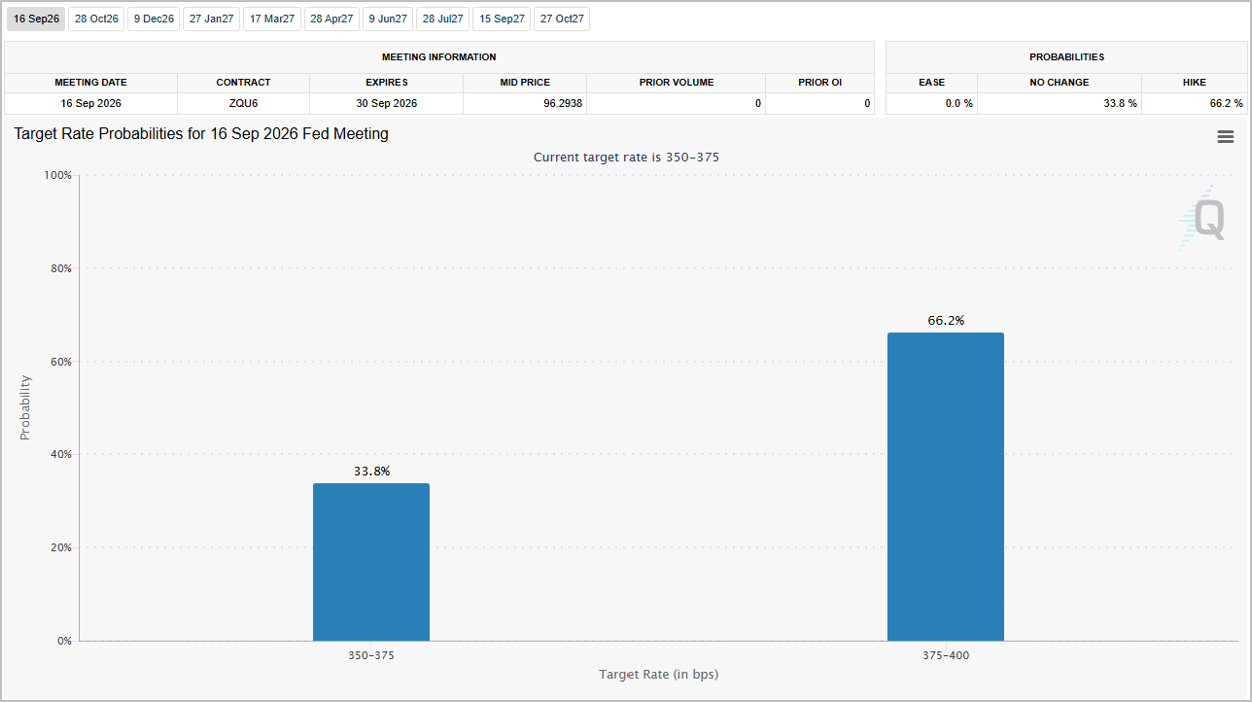
30-Day Fed Funds futures prices for September Fed meeting | Source: CME FedWatch

30-Day Fed Funds futures prices for December Fed meeting | Source: CME FedWatch
The important distinction for commercial real estate investors is that a Fed hike and a move in the 10-year Treasury are not the same thing.
The Federal Reserve directly controls short-term interest rates. The 10-year Treasury is determined by the bond market and reflects expectations around inflation, economic growth, future monetary policy, government borrowing and a host of other factors.
The bond market does not have to wait until September 16.
It is already repricing.
Your investment needs to work in the rate environment that exists today, not the one you hope arrives next year.
If the financing works at today's Treasury, today's SOFR and today's debt constant, increasingly there are lenders willing to provide it.
If the investment requires a 4.00% 10-year Treasury or several Fed cuts to generate the projected return, abundant liquidity doesn't solve the problem.
There is plenty to dislike about a 10-year Treasury approaching 4.80%.
But there is also something encouraging happening beneath the surface.
The commercial real estate credit markets are functioning again.
Lenders have capital. They have appetite. They are competing. Loan volume is increasing. Spreads are tightening.
That is a materially healthier environment than we experienced during much of the past three years.
Unfortunately, lenders can only control their portion of the equation.
The Fed has its greatest impact on the short end of the curve. The bond market controls the long end. And right now, neither is providing much help.
So, as we approach another consequential Fed meeting on September 16, commercial real estate investors find themselves in an unusual position:
Debt is abundant. Cheap debt isn't.
Partner with us to navigate the complexities of commercial real estate. Get in touch today to explore how our expertise can unlock the full potential of your real estate investments.